

TL;DR:
-
Specify infrastructure details and supporting documentation to appeal to experienced restaurant operators.
-
Use a coordinated digital approach maximizing local SEO, review platforms, and targeted email campaigns.
-
Transparency and proven readiness information build credibility, attracting serious and serious prospects.
Marketing a restaurant property is nothing like filling seats on a Friday night. The audience is completely different, their questions are harder, and one vague listing description can cost you months of vacancy. Operators and investors evaluating your space want to know whether they can open quickly, how much infrastructure is already in place, and whether the numbers actually work. To win in this market, you need a strategy built around credibility, data, and the specific concerns of people who think in terms of lease terms, build-out costs, and return on investment.
Table of Contents
-
Craft a consistent digital presence and leverage high-ROI channels
-
Adapt classic restaurant marketing tactics for lead generation
-
Highlight economics and risk-reduction to convert non-turnkey opportunities
Key Takeaways
Point Details
Lead with readiness Highlight kitchen infrastructure, permitting, and operational features in your listings to attract serious buyers.
Systematize digital marketing Use coordinated online channels and consistent messaging to boost property visibility and leads.
Repurpose proven tactics Adapt traditional restaurant marketing strategies for property lead generation and due diligence support.
Focus on buyer economics Showcase the speed and cost advantages of your property, even if it’s not turnkey.
Transparency wins deals Clear, fact-based listings attract serious, motivated buyers and tenants faster.
Set the stage with property readiness and credibility
The single biggest mistake restaurant property owners make is leading with adjectives. “Prime location.” “High-traffic area.” “Great opportunity.” Those phrases say nothing to an experienced operator who has toured dozens of spaces and needs to justify a capital commitment to their partners.
What actually moves the needle is specificity. As the restaurant leasing industry has learned the hard way, you need to “lead with turnkey readiness” but support that claim with documented infrastructure details rather than marketing language. That means showing exactly what is in place:
-
Hood and venting system specifications (CFM rating, last inspection date)
-
Grease trap size and compliance status
-
Gas line capacity and electrical panel amperage
-
Walk-in cooler and freezer dimensions
-
Number of sinks and their classifications
-
Active restaurant permits and health department history
-
Seating capacity for both dining room and any outdoor patio
This is not a checklist to drop in the back of a brochure. It belongs front and center in your listing, because operators use it to estimate their build-out gap from day one. When you understand how second-generation spaces are evaluated, you realize that the technical details are the marketing. Everything else is window dressing.
“A listing that shows the hood is in place, the grease trap is compliant, and the space is restaurant-permitted does more persuasion work in three lines than five paragraphs of narrative copy ever could.”
Beyond the checklist, support your listing with trade-area analysis. Demographics, nearby competition density, average household income, and traffic counts give operators a business context for their investment. Think of it as framing your property not just as a space but as a viable business location. When you’re focused on listing ready-to-open restaurants, that framing is what separates a serious inquiry from a casual browse.

Pro Tip: Include a to-scale layout diagram and at least one test-fit concept showing a potential kitchen configuration. Operators often struggle to visualize a blank space, and a test-fit removes that mental friction immediately.
Craft a consistent digital presence and leverage high-ROI channels
Once your listing communicates the right facts, the next job is making sure the right people actually see it. And that requires a coordinated approach, not a scattered one.
The most effective property marketers treat their efforts like a system rather than a series of one-off promotions. Research from the restaurant industry confirms that a strong marketing motion aligns messaging across owned and digital channels including local SEO, review sites, and email to drive both visibility and conversion. The same logic applies directly to restaurant property marketing.
Here is a practical workflow for boosting your listing’s digital reach:
-
Optimize for local search. Make sure your listing appears when operators search phrases like “restaurant space for lease in [city]” or “second-gen restaurant available.” Use location-specific terms in your listing title, description, and metadata.
-
Claim and update your Google Business Profile. Even for a vacant property, a Google Business Profile can capture search traffic and direct inquirers to your listing.
-
Distribute to review and aggregator platforms. Sites where operators research markets (including broker networks and commercial real estate databases) should carry your listing with consistent details.
-
Build an email sequence for your broker network. A single email to your contact list is forgettable. A three-email sequence that covers property overview, infrastructure highlights, and economics creates a fuller picture and stays top of mind.
-
Retarget engaged visitors. If you have a property website or landing page, retargeting ads on social media platforms keep the listing visible to people who showed initial interest.
-
Document and publicize your property readiness checklist. This content works double duty: it attracts search traffic and qualifies leads because only serious operators take the time to read it.
Using restaurant listing platforms that are built for F&B real estate also amplifies your reach significantly. Generic commercial real estate databases lump your restaurant space alongside office suites and retail storefronts. Specialized platforms reach an audience that is already thinking in terms of hood vents and grease traps, which means your infrastructure details actually land with someone who understands their value.
Pro Tip: Pair your digital listing with a downloadable property readiness checklist in PDF format. Leads who download it are signaling genuine intent, making them much easier to qualify and prioritize for follow-up.
Adapt classic restaurant marketing tactics for lead generation
Traditional restaurant marketing targets diners. But many of its core mechanisms, social proof, event-based visibility, and content that answers real questions, translate well when you redirect them toward operators and investors.
Social proof for property marketing looks different than a five-star Yelp review. What moves buyers and tenants is evidence that other operators succeeded in this space or with your management. That means:
-
Testimonials from previous tenants about build-out ease or landlord responsiveness
-
Before-and-after case studies showing how a past operator transformed the space
-
Revenue or occupancy data from the previous concept (where permissible to share)
-
References from brokers who have worked deals with you before
Event-based visibility is another underused tactic. Broker open houses create urgency and allow your infrastructure to speak for itself in person. Virtual tours with live Q&A sessions are increasingly popular with out-of-market operators who are expanding regionally. A well-run virtual tour that walks through every major infrastructure element builds credibility faster than most written descriptions.
On the content side, consider publishing investment analysis posts that break down the economics of operating from your specific space. What does a comparable rent in your market look like? What is the realistic revenue potential given foot traffic and seating capacity? Operators compare listings as investment-risk tradeoffs, and content that helps them run those numbers positions you as a credible, transparent partner rather than just a seller.
“The landlords who move properties fastest are usually the ones who have done part of the operator’s homework for them. That is not generosity. It is strategy.”
One more angle worth developing is a structured FAQ for the property itself. What zoning allows, what permits transfer, what the build-out timeline looks like, whether the equipment conveys with the lease. When you answer these questions proactively, you eliminate the most common friction points that stall deals. Understanding the differences between a sale and a lease also helps you frame your listing correctly from the start, since the due diligence needs of a buyer and a tenant are meaningfully different.
Highlight economics and risk-reduction to convert non-turnkey opportunities
Not every listing is a plug-and-play turnkey space. Sometimes the kitchen is partially equipped, the permits have lapsed, or the ventilation needs upgrading. That is not automatically a disadvantage. It just requires a different marketing approach.
The key insight here is that operators do not evaluate properties in isolation. They compare them. And when your space is not fully restaurant-ready, your competitive advantage comes from translating the technical readiness into buyer economics, specifically speed to open, reduced build-out risk, and a clearer capital plan.
Here is a comparison that illustrates the difference in marketing framing:
Factor Turnkey listing Partial build-out listing
Time to open 30 to 60 days 90 to 150 days
Estimated build-out cost $0 to $50K $100K to $300K
Infrastructure documentation Full Partial, with gap analysis
Permit status Active and transferable Requires renewal (timeline provided)
Capital risk for operator Low Moderate, with clear ceiling
Marketing emphasis Speed and certainty Cost control and customization
When your space falls in the partial build-out category, the goal is to give operators a ceiling, not just a floor. Provide a realistic cost range for completing the build-out, cite local contractor estimates if you have them, and show the timeline to opening day. Operators can work with uncertainty if you quantify it honestly. What they cannot work with is a listing that forces them to guess at every line item.
Reviewing expert restaurant real estate tips consistently shows that landlords who provide sample capital plans, even rough ones, attract more serious offers and spend less time in diligence than those who leave operators to figure it out alone.
Pro Tip: Commission a simple capital planning document from a restaurant build-out contractor before listing. Even a two-page cost estimate broken down by category (electrical, plumbing, equipment, finishes) dramatically reduces how many back-and-forth calls your listing generates.
Side-by-side comparison of marketing tactics
To make the right choices for your specific property and timeline, use this comparison to weigh your options:
Marketing tactic Best for Setup speed Lead quality Cost level
Infrastructure-first listing All property types Fast Very high Low
Local SEO and digital presence Lease-focused landlords Medium High Low to medium
Broker open house High-value or complex spaces Medium Very high Medium
Virtual tour with Q&A Out-of-market buyers Fast High Low
Trade-area analysis content Investment-ready buyers Slow Very high Medium
Capital plan documentation Non-turnkey listings Slow High Low to medium
Specialized listing platform All property types Fast Very high Low
For landlords with a property that checks most of the turnkey boxes, the fastest path to serious inquiries is a specialized listing with full infrastructure documentation paired with a focused digital presence. For more complex or non-turnkey properties, the investment in capital planning documentation and trade-area content pays back quickly in reduced time on market and fewer low-quality inquiries.
When you’re evaluating expansion locations from an operator’s perspective, the same logic applies. The best listings answer the questions operators are already asking, and the table above helps you match your tactics to the answers they need most.
Why most restaurant property marketing misses the mark, and what actually attracts buyers who are ready to move
Here is the uncomfortable truth about restaurant property marketing: most of it is built for the wrong audience. Landlords and sellers often default to the same promotional instincts they use when marketing their own restaurants, colorful descriptions, lifestyle photos, and vague claims about potential. But sophisticated operators are not moved by potential. They are moved by proof.
The listings that move fastest share three traits. First, they lead with numbers. Not estimates or ranges, but documented figures: utility averages, equipment replacement values, prior sales volume if available. Second, they open faster, spend less by removing ambiguity from the capital planning process. Third, they communicate transparently about what is there and what is not, without burying the gaps in footnotes.
Generic buzzwords actively hurt your listing with experienced operators. When someone who has opened four locations reads “turnkey opportunity in a high-traffic corridor,” they immediately discount it because they have been burned by that language before. Replacing those phrases with a grease trap compliance date, a ventilation CFM rating, and a permit transfer timeline builds the kind of credibility that actually generates offers.
The deeper lesson is that transparency is not a risk in restaurant property marketing. It is a conversion tool. The operators you want to attract are running their own due diligence regardless of what your listing says. When your listing answers their questions before they ask them, you are not just saving time. You are signaling that you are the kind of landlord or seller they can work with, and that matters as much as the square footage.
Next steps: List, optimize, and close with PepperLot
Ready to put these ideas into action? PepperLot was built specifically for moments like this.
[
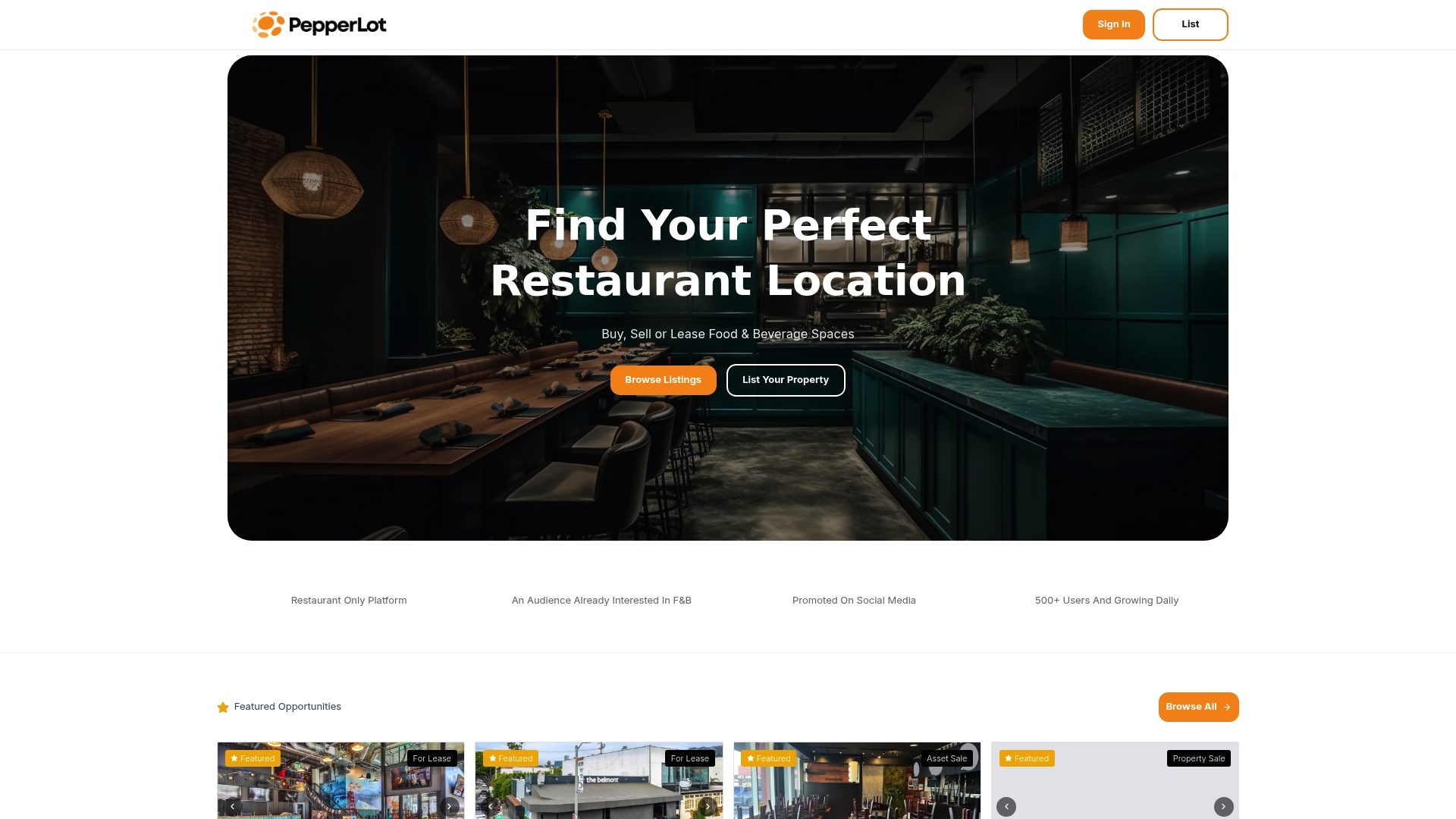
Unlike general commercial real estate platforms, PepperLot focuses exclusively on restaurant and food and beverage properties. Every listing field is designed around the details operators actually care about: grease traps, seating capacity, permit status, and kitchen configuration. When you list here, you are not competing for attention alongside office suites. You are front and center in front of an audience of over 500 active operators, landlords, and brokers who are already looking for exactly what you have. Browse current lease opportunities to see how top listings are structured, or explore the location intelligence tools to back your listing with the demographic and market data that serious buyers demand.
Frequently asked questions
What details do operators care about most when researching a restaurant property listing?
Operators prioritize infrastructure readiness above everything else, specifically kitchen configuration, venting, grease trap compliance, and permit status. As industry research confirms, “infrastructure and lease-ready details” outperform any amount of descriptive language in driving serious inquiries.
How can I make my restaurant property stand out online?
Lead with documented readiness details, include high-quality photos alongside layout diagrams, and distribute your listing through local SEO and specialized platforms. A coordinated digital channel approach consistently outperforms single-channel promotion in generating serious inquiries.
Are property marketing strategies different from marketing a restaurant to diners?
Completely different. Property marketing must support investment decisions and due diligence, not brand affinity. As noted across the industry, adapting diner-focused tactics for tenant and buyer lead generation requires shifting the focus from experience to economics.
What’s the main benefit of marketing a second-generation restaurant space?
Second-generation spaces let operators open faster and with significantly lower upfront capital than a raw build-out. Leading your listing with proof that the “hood, venting, grease trap, and restaurant-permitted use” are already in place is the fastest path to attracting a serious offer.
Recommended
Browse restaurants for sale and sell a restaurant on PepperLot.
Continue on PepperLot
Ready to take the next step? Use the primary marketplace page for this topic.
Browse restaurants for sale on PepperLot