
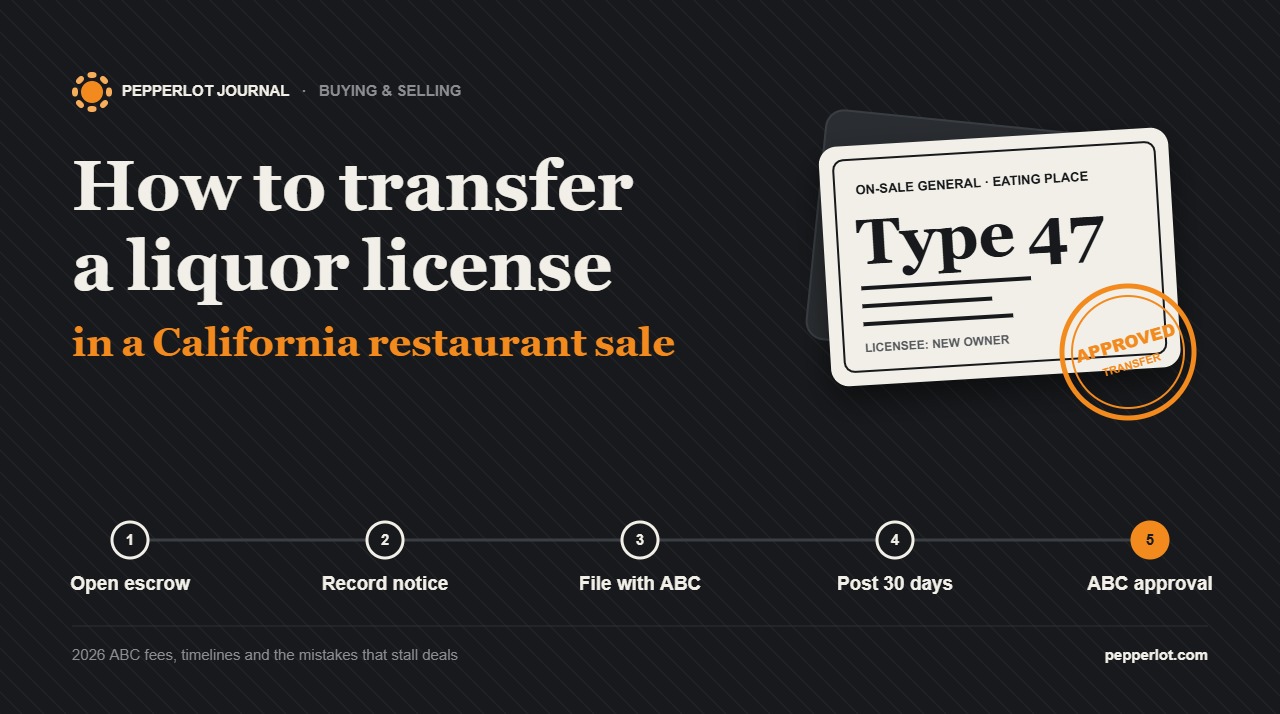
Short answer: in California, a liquor license moves to a new restaurant owner through a person to person transfer approved by the Department of Alcoholic Beverage Control (ABC). Buyer and seller file a joint application, record a Notice of Intended Transfer, run the purchase price through escrow, post the premises for 30 days, and wait for ABC to investigate the buyer. With a full liquor license, the state transfer fee is $1,565 plus the annual fee. The license itself is the expensive part, and the process is where deals get delayed or fall apart.
For many California restaurants, the liquor license is one of the most valuable assets in the sale. In Los Angeles County, a full liquor license cannot simply be applied for. It has to be bought from someone who already holds one. That makes the transfer a central part of the deal, not paperwork to handle after closing. This guide walks through how the transfer works, what it costs, how long it takes, and the mistakes that cost buyers and sellers money.
Which license does the restaurant actually have?
Before anything else, confirm the license type and its status using the ABC License Lookup. Three types cover most restaurants:
-
Type 41, On Sale Beer and Wine, Eating Place. Beer and wine only. Not limited by a county quota, so a new one can be applied for directly at a modest state fee.
-
Type 47, On Sale General, Eating Place. Beer, wine, and spirits. The premises must operate as a bona fide eating place, meaning a real restaurant that regularly serves meals. Minors are allowed.
-
Type 48, On Sale General, Public Premises. A bar license. Beer, wine, and spirits with no food requirement, and no one under 21 allowed inside.
Type 47 and Type 48 are general licenses, and the number of general licenses in each county is capped based on population. Los Angeles County has been at its cap for years. New general licenses are released only through ABC's annual priority drawing when population growth allows, and winners pay a $19,840 application fee. Everyone else buys an existing license on the secondary market, which is why a Type 47 attached to a restaurant for sale carries real value.
The lookup also shows the license's conditions, such as restricted hours, no live entertainment, or limits on outdoor service. Those conditions transfer with the license. A buyer who plans a late night concept needs to know about an 11 p.m. cutoff before signing, not after.
How the transfer works, step by step
1. Agree on the deal and open escrow
California law requires an escrow for the sale of a retail liquor license when money changes hands. The purchase agreement should state the license price separately or clearly include it in the total, and the escrow instructions should make closing conditional on ABC approving the transfer. Use an escrow company that handles liquor license transfers regularly. It is a specialized area with its own deadlines.
2. Record the Notice of Intended Transfer
The parties record a Notice of Intended Transfer with the county recorder. This notice exists to give the seller's creditors a chance to file claims against the escrow. The escrow holder pays valid claims, including amounts the seller owes to state tax agencies, out of the purchase price before the seller receives the balance.
3. File the transfer application with ABC
Buyer and seller file the application together at the ABC district office that covers the premises. Los Angeles County is split among several district offices, so check ABC's district office finder for the right one. Expect to provide personal history information and fingerprints for each owner, an entity's formation documents, a premises diagram, and proof of the legal right to occupy the space, which usually means the lease or an assignment of it. Within 30 days of filing, the buyer must give ABC a sworn statement that the full purchase price has been deposited into escrow.
4. Post the premises and complete any mailed notice
The buyer posts a public notice of the application at the restaurant entrance for 30 days. In some cases, notice must also be mailed to residents within 500 feet. During that window, neighbors, organizations, and local agencies can file protests. A protest can add weeks or months, so a location with a history of complaints deserves extra due diligence before going into contract.
5. ABC investigates and approves
ABC reviews the buyer's background, funding sources, and the premises. If everything checks out, ABC approves the transfer, notifies escrow, and escrow closes. The license is then issued in the buyer's name.
Can the buyer keep serving alcohol during the transfer?
Often, yes. ABC can issue a temporary permit that lets the buyer operate under the license for up to 120 days while the transfer is pending. The fee is $100. The seller has to authorize it, the premises must have been operating under the license within the 30 days before the permit application, and issuance is at ABC's discretion. Temporary permits are for person to person transfers at the same location, not moves to a new address.
For buyers, this is the difference between taking over a running bar program and reopening dry. For sellers, it means agreeing in the purchase contract on who carries the risk if the transfer is ultimately denied after the buyer has been operating.
What a liquor license transfer costs
ABC fees are small compared to the license price. Current fees, effective January 1, 2026:
Item Fee
Person to person transfer, general license (Type 47 or 48) $1,565 plus annual fee
Person to person transfer, beer and wine (Type 41) $420 plus annual fee
Premises to premises transfer (moving a license to a new location) $975
Double transfer (new owner and new location), general license $1,565 plus annual fee
Temporary permit $100
Condition modification $595
New general license through priority drawing $19,840
Source: California ABC application fee schedules. Confirm current fees with ABC before filing.
The real cost is the market price of the license itself. Published price ranges for a Los Angeles County Type 47 vary widely, from tens of thousands of dollars to several hundred thousand, and much of what circulates online is not tied to actual closed sales. Price depends on the county, current supply, and whether the license is active and clean. Get current quotes from a licensing broker or escrow officer who closes these transfers every month rather than relying on a number you read online, including in this article.
Add escrow fees, attorney or licensing consultant fees, and any local permits. In the City of Los Angeles and many other cities, serving alcohol may require a conditional use permit or other land use approval. If the existing approval does not cover the buyer's plans, or has lapsed, that becomes its own process. See our guide to zoning requirements before signing a restaurant lease in California.
How long does it take?
A clean person to person transfer in Los Angeles County commonly takes a few months from filing to approval. The 30 day posting period is the floor, not the estimate. Protests, incomplete applications, questions about the buyer's funding, or a premises that also needs local approval can stretch that considerably. Build the timeline into the purchase agreement and the lease assignment so neither side is forced to close before ABC approves.
Seven mistakes that derail restaurant liquor license transfers
-
Closing the restaurant before the transfer. If a licensed premises is closed for 15 consecutive days, the license must be surrendered to ABC. A surrendered license can still be transferred within the surrender period, but it complicates the temporary permit and the deal. Sellers should keep the doors open until the buyer takes over.
-
Ignoring the lease. ABC needs proof the buyer can legally occupy the space. If the landlord has not approved the lease assignment, the license transfer stalls with it.
-
Not reading the conditions. Hours limits, entertainment bans, and food sales requirements follow the license. Changing them is a separate petition to ABC that can be protested and is not guaranteed.
-
Unclear funding sources. ABC examines where the buyer's money comes from. Undisclosed partners or investors, or funds that cannot be traced, are a common cause of delay.
-
Underestimating the seller's debts. Unpaid sales tax, payroll obligations, and other creditor claims are paid from escrow. A seller who owes more than the license is worth will not walk away with cash, and the deal may not close at all.
-
Treating a Type 41 as a Type 47. A beer and wine restaurant does not come with spirits rights. If the buyer's concept depends on cocktails, a general license has to be bought and transferred to the premises separately.
-
Assuming an LLC sale avoids ABC. Selling 50 percent or more of the ownership in a licensed company is treated as a stock or membership transfer and still requires ABC approval and fees.
Another source of licenses: state tax auctions
The California Department of Tax and Fee Administration (CDTFA) seizes liquor licenses from businesses that owe sales tax and sells them at public auction. Many are Type 47 licenses issued in Los Angeles County. The winning bidder must open an approved escrow and deposit the full price within 48 hours, apply for the ABC transfer within 30 days, and still pass ABC's review before escrow closes. It is a legitimate route for a buyer who already has a location secured, but the license usually has to be moved to a new premises, which means a double transfer and more review. CDTFA posts upcoming sales on its website.
What this means if you are buying or selling a restaurant
Buyers: confirm the license type, status, and conditions before making an offer. Make ABC approval a condition of closing, request a temporary permit, and line up the landlord's consent at the same time. A restaurant listed with an active Type 47 can save months compared with buying a license separately. Browse restaurants for sale on Pepperlot and ask the listing broker for the license number on day one.
Sellers: the license may be worth more than your equipment. List the license type in your marketing, gather your ABC documents early, settle tax issues before you go to market, and keep operating until closing. Our guide on preparing your restaurant for sale covers the rest of the checklist, and you can list your restaurant on Pepperlot to reach buyers looking specifically for second generation space.
For the other permits a takeover involves, see the California restaurant permit and license checklist and our guide to working with the LA County health department when you take over an existing restaurant.
Frequently asked questions
Can a liquor license be transferred to a new owner in California?
Yes. Most California retail licenses, including Type 41, Type 47, and Type 48, can be transferred to a new owner through a person to person transfer. ABC must approve the buyer, and the sale must go through escrow.
How much does it cost to transfer a Type 47 license in California?
The ABC person to person transfer fee for a general license is $1,565 plus the annual license fee, as of January 1, 2026. The price paid to the seller for the license is negotiated separately and is usually far larger than the state fees.
How long does a liquor license transfer take in Los Angeles?
Plan on a few months. The public notice must be posted for at least 30 days, and ABC's investigation, any protests, and local approvals add time. A temporary permit can let the buyer operate for up to 120 days while the transfer is pending.
Can I move a liquor license to a different location?
Yes, through a premises to premises transfer, or a double transfer if the owner is also changing. ABC reviews the new location, the public can protest, and moving a general license into a different county is generally limited to intercounty priority drawing winners.
Does the liquor license come with the restaurant automatically?
No. The license belongs to the licensee, not the building. It has to be included in the purchase agreement and transferred through ABC. Confirm in writing whether the license is part of the sale and at what price.
What happens to a liquor license if a restaurant closes?
If a licensed premises is closed for 15 consecutive days, the license must be surrendered to ABC. It can be reactivated or transferred during the surrender period, but renewal fees still have to be paid.
This article is general information, not legal advice. ABC rules and fees change. Confirm requirements with your local ABC district office, a licensing attorney, or an experienced escrow officer before you sign. Fees reflect the ABC schedule effective January 1, 2026. Last reviewed October 2026.